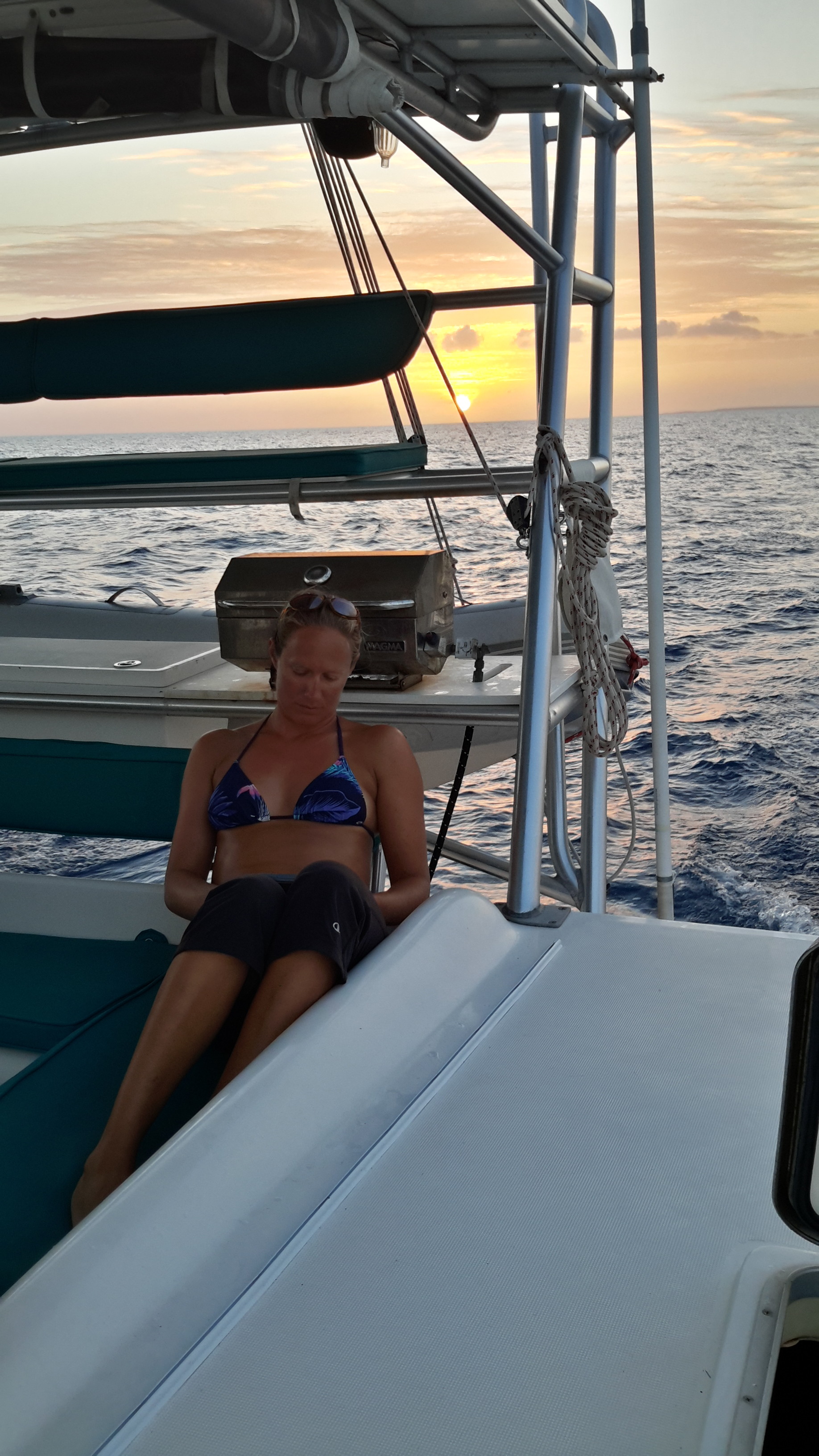
Adventures in cruising abound. Over the last few weeks, we have visited more beaches (and beach bars) than I can count. I’ve learned a sun-burn lesson about switching to bikinis with less coverage and a knife lesson about cutting apples while underway. Of course, I’ve also learned to drive a dinghy, read a radar screen, and find the dock with the best deal on water.
On Friday, I had a true first: sailing out of sight of land. We’ve been on cruising trips before and we’d had more than two weeks in the BVI, but even my longest day sailing had never taken me out of sight of land. We knew that the 70-something mile crossing from Virgin Gorda in the BVI to Anguilla (an island nation North of St. Maarten) was going to be the first real sail and for a few days before it I had been getting stressed. I had the feeling you get when you have an exam coming and you know you haven’t studied enough (or at all). Luckily for me, my husband and our lovely crew didn’t throw me overboard when I got snappish and touchy.
When you’re sailing and you have a long distance to cross the one thing that will ruin your trip is wind coming from exactly where you’re heading. We’d been hoping for a Northerly wind that would push us straight to Anguilla with little motoring and a speed over 7 knots. There were about two days of Northerly wind, but they happened while R’s mom and aunt were with us – a full week before we could leave the BVI. So we kept watching the weather, knowing that we wanted to get to St. Maarten before my parents arrive on the 27th. The reports were not good and were only getting worse. Even motoring, we’d only be able to make 5 knots in the best case and 3 or so in the worst. Suddenly the 70 mile trip was going to take over 14 hours and we’d be running the engines the whole time.
Then we had a choice, do we make the passage at night or during the day. We knew we wanted to arrive in Anguilla during the day so that we could see where we were going (and more importantly, where we were dropping anchor). But if we did the crossing over night, it meant taking watches during which I would be the most experienced sailor conscious. Hence, the feeling like I hadn’t prepared enough for the exam. The passage between Virgin Gorda and Anguilla is also heavily populated by freighters and cruise ships, most of which make the crossing during the night. Ultimately, we decided to spend one last day on the beach in Leverick Bay and leave before sunrise with R taking the first watch and me taking a shift at some point during the day.
So the alarm went off at 3:30 a.m. and R snuck out of bed to cast us off the mooring ball and start the trip to Anguilla. By the time I got up to see the sunrise, Virgin Gorda was quickly disappearing from the horizon. All around us was blue water, blue sky, and clouds. I took a short shift at the wheel (after unsuccessfully trying to make a hot cup of tea) and found myself wondering how sailors did this without compasses or stars to guide them. There’s no reference point; no feature to guide you. Luckily for us, we have GPS, a magnetic compass, and autopilot.
As we crossed we saw seabirds landing in sargossa grass islands, like desert oases in the long flight between islands. At about four o’clock in the afternoon, Anguilla’s outlying islands began to appear on the horizon and R cried, “land ho,” much to everyone’s pleasure. It took us over three more hours before we made it to the harbor. Along the way, I spotted a whale spouting and we watched attentively as it breached and tail slapped. We watched the sunset behind us, looking for the mythological green flash and counting as it was going, going, going, gone.